
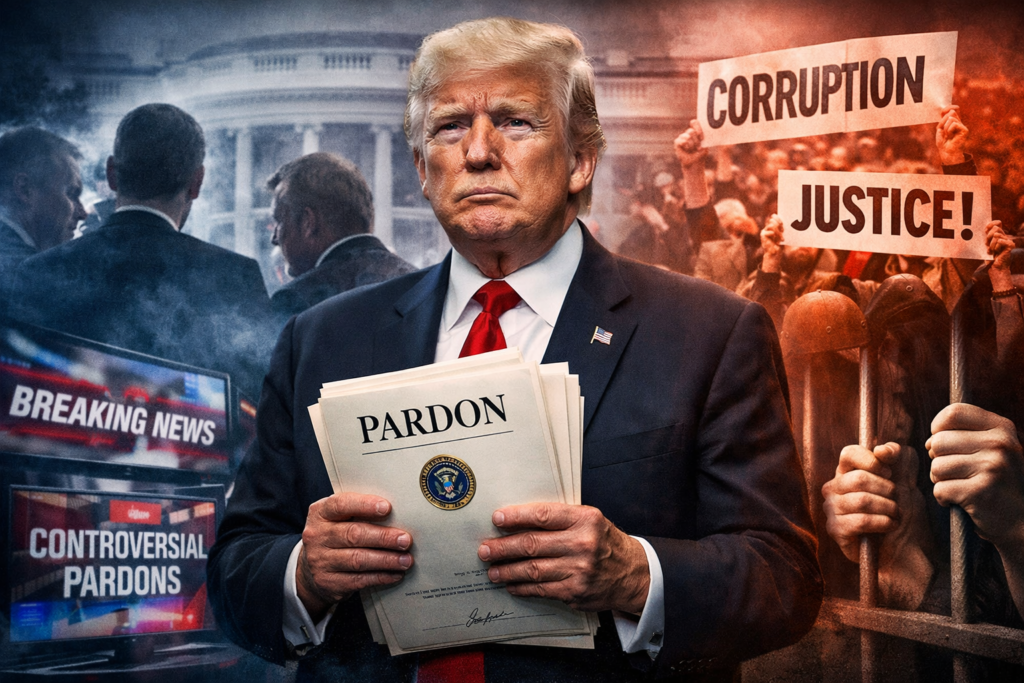

The reactions to President Donald Trump’s wave of pardons were swift and intense. Cable news lit up. Social media exploded. Critics shouted corruption. Supporters shouted “Justice.” But what stood out most wasn’t just who was pardoned. It was how the decisions were made. It was also how suddenly they were announced.
Even members of Trump’s own inner circle were reportedly blindsided.
That detail matters. When the people closest to a president don’t see major decisions coming, it raises a bigger question than party politics. Who is really in control? How carefully is that power being used?
Yes, He Had the Power—But Power Isn’t the Whole Story
Let’s get one thing straight right away. Trump was absolutely within his constitutional rights. The president has broad authority to grant pardons for federal crimes. There’s no requirement to ask Congress. There’s no need to consult the courts. And there’s no legal obligation to follow the Justice Department’s pardon process.
So from a legal standpoint, the debate ends quickly.
But politics isn’t just about what’s legal. It’s about trust, norms, and responsibility. And that’s where Trump’s pardon spree becomes more troubling.
Presidential pardons are supposed to be rare and thoughtful. Historically, they’re meant to correct injustices, show mercy, or acknowledge that the law doesn’t always get it right. They aren’t meant to look like rewards, favors, or impulsive decisions.
Trump blurred that line—badly.
Surprise Pardons, Surprise Reactions
Reports indicating that aides were taken aback reveal a significant development. This wasn’t just a president adhering to advice and acting decisively. This was a president acting alone.
In some cases, pardons were announced with little warning. There was no extensive documentation involved. There was no visible vetting process in place. Just decisions dropped into the news cycle like grenades.
That leadership style might appeal to people who hate bureaucracy. But when it comes to the justice system, unpredictability isn’t a virtue. It creates uncertainty, invites suspicion, and weakens confidence in fairness.
If even top advisers didn’t know what was coming, how can the public trust the reasoning behind it?
The Problem Isn’t Mercy—It’s Selectivity
Not all of Trump’s pardons were controversial. Some involved nonviolent offenders or people who arguably deserved a second chance. Those cases didn’t anger most Americans.
The outrage stemmed from the inclusion of other individuals.
High-profile figures. Political allies. People with power, money, or influence. That pattern led to accusations. People claimed the pardon power was being used as a political shield. It was not serving as a moral tool.
Everyday Americans serve full sentences. Well-connected figures often get clemency. It sends a clear message, and it’s not a good one.
Justice should be blind. Trump’s pardon spree made it look like justice knows exactly who you are.
Supporters See Strength, Critics See Abuse
Trump supporters argue that the justice system itself is flawed, politicized, and unfair—and they’re not entirely wrong. There are real problems with over-sentencing, selective prosecution, and unequal outcomes.
From this viewpoint, people perceive Trump’s pardons as a necessary disruption. A president pushing back against institutions that have lost public trust.
But disruption without discipline becomes chaos.
You can criticize the system and still follow a process. You can challenge norms without turning justice into a guessing game.
That’s where Trump lost many Americans who otherwise would have listened.
This Is Bigger Than Trump
The most uncomfortable part of this story is what it reveals about the presidency itself. Trump didn’t invent the pardon power. He simply showed how easy it is to stretch it.
If one president can issue surprise pardons with little oversight, so can the next. And the one after that.
Once norms are broken, they’re difficult to restore.
The Constitution assumes good faith. It assumes restraint. It assumes leaders will use their powers wisely. But it doesn’t guarantee they will.
Trump’s pardon spree clearly revealed this weakness.
A Legacy That Won’t Fade
Trump’s approach to pardons will continue to shape his legacy long after individual cases fade from memory. To supporters, it will be remembered as bold, defiant, and unapologetic. To critics, it will stand as an example of power used without enough care.
Both sides will argue for years.
But one thing is clear: the conversation about pardons has changed. Americans are now asking harder questions about executive power. They are questioning not just who holds it, but also how much trust we should place in it.
Final Thought
Trump’s pardon spree wasn’t illegal. It wasn’t hidden. And it wasn’t subtle.
But legality alone doesn’t make something right.
In a country built on laws, traditions, and trust, presidents are expected to do more than follow the rules. They’re expected to respect the spirit behind them.
Trump didn’t just test the limits of presidential power — he reminded us how fragile those limits really are.
And that’s a lesson the country shouldn’t ignore.