
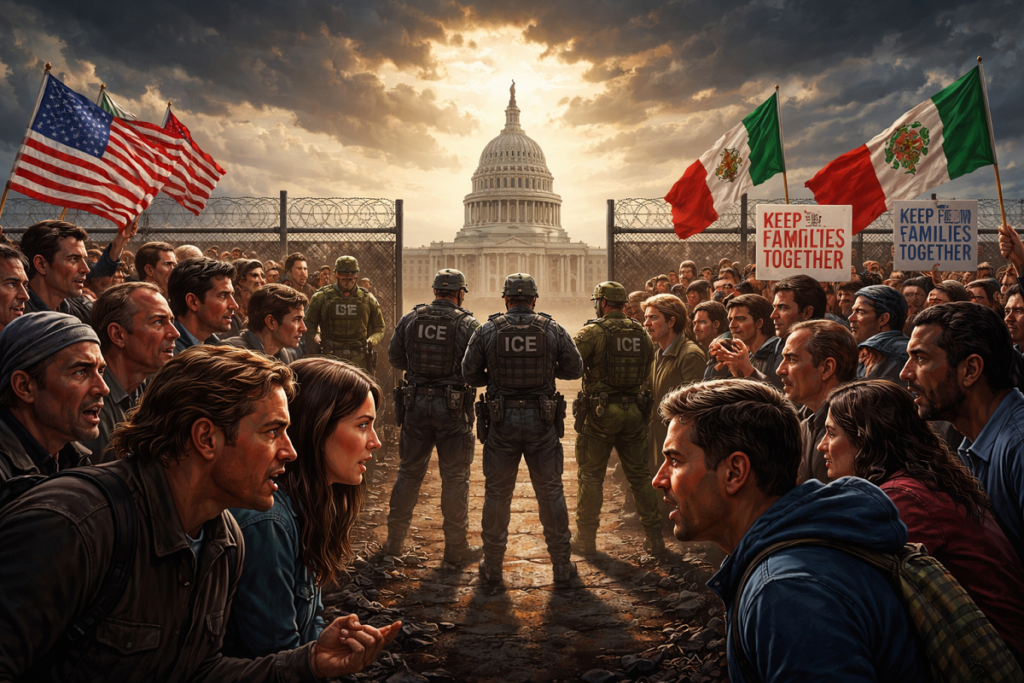

There’s a tension in the country right now that you can feel without turning on the news. It’s in comment sections. It’s at family dinners. It’s in the way people talk past each other instead of to each other.
Few topics bring that tension out faster than immigration — and especially ICE.
Ask one group and ICE is essential for law and order. Ask another and ICE is a symbol of cruelty and fear. Somewhere in between is a country that seems exhausted, angry, and unsure how to move forward.
So let’s take this one piece at a time.
Is ICE Necessary?
At its core, ICE — Immigration and Customs Enforcement — exists to enforce immigration laws passed by Congress. That’s the simple, unglamorous truth.
Every country enforces its borders in some way. That’s not controversial globally, even if it’s explosive in American politics. Laws exist. Someone has to enforce them. If immigration law exists at all, then enforcement will exist in some form.
So yes, some version of immigration enforcement is necessary. But here’s where the conversation usually breaks down. People aren’t just debating whether laws should be enforced. They’re debating how they’re enforced, who gets targeted, and what values guide that enforcement.
Supporters of ICE argue:
- No country can function without borders.
- Unchecked immigration strains housing, schools, healthcare, and wages.
- Law enforcement agencies don’t get to pick which laws they like.
Critics argue:
ICE tactics are often aggressive, opaque, and traumatizing, Families get torn apart for non-violent offenses. Enforcement has become detached from basic human dignity. Both sides are talking about real things. That’s what makes it messy.
The real issue isn’t “ICE vs no ICE.”
It’s whether enforcement can exist without becoming dehumanizing.
And that’s where trust breaks.
Why All the Violence and Hatred?
The anger didn’t start with ICE. ICE became a lightning rod for something deeper.
People are angry because they feel unheard.
They’re afraid because they feel unstable.
They lash out because they think the other side is trying to erase their way of life.
Fear always looks like anger from the outside.
For some Americans, immigration feels like chaos — jobs changing, neighborhoods changing, language barriers, rising costs. They don’t feel racist; they feel overwhelmed. When they’re told their concerns make them evil, they dig in harder.
For others, ICE represents something terrifying — raids, detentions, parents disappearing, kids left behind. When you live with that fear, every badge looks like a threat.
Now add:
- Social media outrage algorithms
- Politicians rewarded for inflaming division
- News cycles that profit from fear
- Years of economic pressure and cultural whiplash
- You don’t get conversation.
- You get tribal warfare.
Violence grows when people stop seeing each other as human and start seeing each other as symbols. “The enemy.” “The threat.” “The problem.”
Once that line is crossed, cruelty becomes easy.
What’s Actually Needed for a Peaceful Solution?
Here’s the part nobody likes hearing: there is no single policy fix.
Peace doesn’t come from one bill, one agency reform, or one election. It comes from systems that reduce fear instead of amplifying it.
That starts with a few uncomfortable truths.
1. Immigration Law Is Broken — and Everyone Knows It
We’ve patched the system for decades instead of fixing it.
Legal immigration pathways are slow, confusing, and often unrealistic. Asylum systems are overwhelmed. Courts are backlogged. Enforcement is inconsistent. That chaos benefits smugglers, bad actors, and political opportunists — not citizens or migrants.
A peaceful solution requires:
- Clear, modernized immigration laws
- Faster, fairer legal pathways
- Real consequences for exploitation by employers and traffickers
Order reduces fear. Chaos feeds it.
2. Enforcement Must Be Accountable
Enforcement without transparency breeds abuse.
Enforcement without oversight breeds distrust.
If ICE (or any enforcement agency) is going to exist, it has to operate under:
- Clear rules of engagement
- Independent oversight
- Consequences for misconduct
- A focus on serious threats, not indiscriminate targeting
Law enforcement doesn’t lose legitimacy because it enforces laws. It loses legitimacy when people believe it doesn’t answer to anyone.
3. Human Dignity Has to Be Non-Negotiable
This shouldn’t be controversial, but it is.
You can enforce laws and treat people humanely. Those things are not opposites.
That means:
- Ending family separation as a default tool
- Ensuring due process
- Treating migrants as people, not statistics
When dignity disappears, resistance hardens.
4. Language Matters More Than People Admit
Words shape reality.
When politicians talk about “invasions,” violence feels justified.
When activists paint all enforcement as evil, compromise becomes betrayal.
A peaceful solution requires leaders who lower the temperature instead of spiking it. That doesn’t mean being weak. It means being responsible.
Is There Any Chance of Reuniting the Country?
Short answer: yes — but not the way people think.
The country won’t reunite around agreement.
It will reunite around tolerance for disagreement.
America has never been unified in the sense people romanticize. We’ve always argued. Loudly. Sometimes badly. The difference now is that disagreement has turned into moral exile.
“You’re not just wrong — you’re dangerous.”
That mindset kills unity.
Reuniting the country will take:
Accepting That Half the Country Isn’t Evil
This sounds obvious. It isn’t.
People need to relearn how to say, “I don’t agree with you, but I understand why you feel that way.”
That single sentence is more powerful than a thousand debates.
Decentralizing the Fight
Not every issue needs to be a national cage match.
Local solutions — tailored to local realities — reduce the sense that one side is forcing its will everywhere at once. Federalism isn’t a flaw. It’s a pressure valve.
Leaders Willing to Lose Applause
Real unity won’t come from viral soundbites. It will come from leaders willing to tell their own side uncomfortable truths.
That kind of leadership doesn’t trend. It also doesn’t destroy countries.
Citizens Choosing Curiosity Over Rage
This part isn’t on politicians. It’s on regular people.
Every time someone chooses to ask instead of attack, the temperature drops a degree. Enough degrees and the whole system changes.
The Hard Truth
There is no perfect answer to immigration. There never has been.
There are only trade-offs:
- Order vs openness
- Security vs compassion
- Speed vs fairness
The question isn’t whether ICE should exist or disappear overnight. The question is whether the country can build systems that enforce laws without losing its moral compass — and whether citizens can argue fiercely without tearing each other apart.
Peace isn’t silence.
Unity isn’t sameness.
And disagreement isn’t hatred — unless we let it become that.
The country doesn’t need everyone to agree.
It needs people to remember they’re still on the same side of the table.